
Table of Contents
ToggleIntroduction
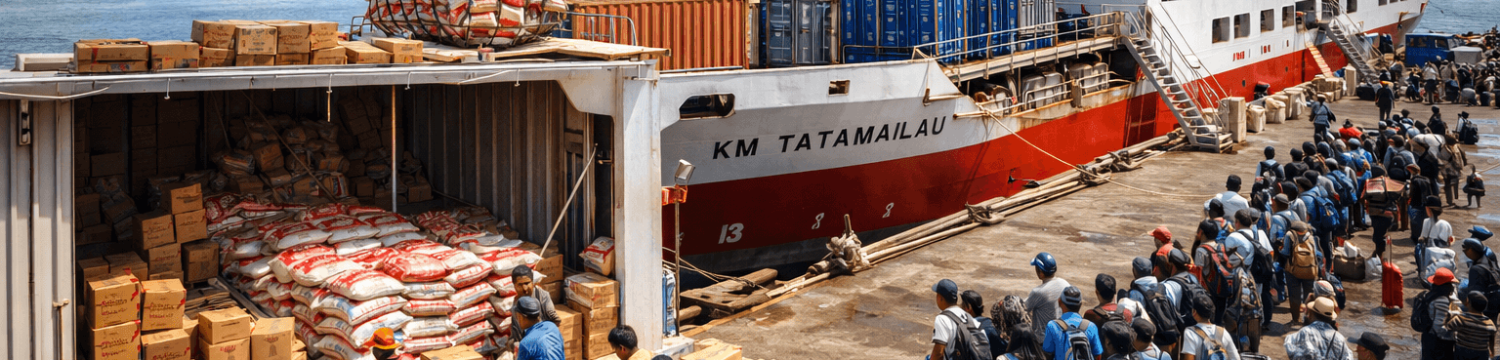
In the vast and complex archipelagic waters of Eastern Indonesia, the distinction between passenger transport and logistics often blurs. The need for speed and regularity in delivering essential goods to remote areas cannot always wait for dedicated cargo freighters. Entering early 2026, KM Tatamailau, one of PT PELNI (Persero)’s stalwarts, has solidified its role not just as a people mover, but as a critical artery for Eastern Indonesia sea logistics 2026.
While the world focuses on massive container ships, the real battle for economic equity in Indonesia is fought in the ports of Agats, Kaimana, and Tual. Here, the arrival of KM Tatamailau is synonymous with the restocking of markets and the stabilization of prices.
This article analyzes how KM Tatamailau maintains the supply chain continuity in the first quarter of 2026, bridging the gap between North Sulawesi, Maluku, and the depths of Papua, and why its dual-role capability is indispensable for the region’s economic resilience.
The Strategic Route: Connecting the disconnected
In 2026, KM Tatamailau continues to operate on one of the most challenging yet vital routes in the PELNI network. Its trajectory creates a unique “logistics loop” that binds the economic hubs of the north with the developing frontiers of the south.
The 2026 Voyage Pattern
The vessel’s primary route—Bitung, Ternate, Ambon, Tual, Dobo, Timika, Agats, to Merauke—serves as a lifeline.
-
Bitung & Ternate: Acting as sourcing hubs where manufactured goods and agricultural products are loaded.
-
Agats (Asmat): Perhaps the most critical stop. As a riverine port with limited access for large draft vessels, KM Tatamailau’s scheduled arrival is the primary method for bringing in FMCG (Fast-Moving Consumer Goods) and taking out local produce.
-
Merauke: As the easternmost anchor, it serves as the distribution point for the South Papua province.
Beyond Passengers: The Logistics Imperative
While designed as a passenger liner, KM Tatamailau’s role in Eastern Indonesia sea logistics 2026 has evolved. It utilizes its deck space and cargo holds to transport “Redpack” (General Cargo) and essential commodities that require faster transit times than traditional “Tol Laut” cargo ships.
Speed vs. Volume
Dedicated cargo ships can take weeks to accumulate a full load. KM Tatamailau, running on a strict passenger schedule, offers “Express Logistics” capabilities.
-
Perishables: Fresh produce from Ambon or fish from Dobo can reach buyers in Timika or Bitung within days, preserving value and reducing waste.
-
Emergency Restocking: In early 2026, following the high consumption of the holiday season (Nataru), retailers in 3TP regions relied on PELNI ships to quickly replenish stock before the arrival of larger bulk freighters.
General Cargo & Redpack Growth
Data from early 2026 suggests a surge in “Redpack” shipments—smaller, consolidated cargo parcels sent by MSMEs (UMKM). Traders in Ternate are increasingly using KM Tatamailau to send processed spices and crafts to tourists and buyers in Sorong and Ambon, effectively using the ship as a floating courier service.
Need reliable cargo schedules for Eastern Indonesia? Get the latest 2026 Cargo Manifest & Schedule for PELNI ships serving Papua and Maluku. [Download the Shipping Schedule]
Stabilizing Prices in 3TP Regions
The ultimate measure of success for Eastern Indonesia sea logistics 2026 is inflation control. KM Tatamailau plays a direct role in this macroeconomic indicator.
The “Tol Laut” Synergy
While not a subsidized “Tol Laut” cargo ship per se, KM Tatamailau complements the program. By carrying high-value, low-volume goods, it prevents scarcity-driven inflation.
-
Case Study: Agats: In the absence of regular shipping, prices for cement, rice, and instant noodles in Agats can spike by 50%. The regular bi-weekly calls of KM Tatamailau ensure that shelf prices remain stable, narrowing the disparity with Java or Sulawesi.
Supporting Local Economies (Muatan Balik)
The logistics flow is not one-way. From Merauke and Dobo, the ship returns carrying local marine products (fish, shrimp) and agricultural yields. This “Muatan Balik” capability provides income to local fishermen who need a reliable way to get their catch to the processing plants in Bitung or Ambon.
Operational Excellence in 2026
Maintaining this mobility requires operational discipline. In 2026, PELNI has implemented stricter maintenance and docking schedules to ensure KM Tatamailau remains seaworthy despite the rough Arafura Sea conditions.
-
Digital Tracking: Shippers can now track their parcels aboard KM Tatamailau via PELNI’s integrated logistics apps, providing visibility that was previously available only to containerized cargo.
-
Port Handling Efficiency: Collaborations with Pelindo in ports like Ambon and Bitung have reduced the loading/unloading time (dwelling time) for general cargo, ensuring the ship departs on schedule to meet its passenger commitments.
Conclusion
As we navigate through 2026, KM Tatamailau stands as a testament to the resilience of Indonesia’s maritime strategy. It proves that in the remote waters of Eastern Indonesia, the most effective supply chain solution is one that combines human mobility with logistics capability.
By maintaining the flow of goods to Agats, Merauke, and beyond, KM Tatamailau does more than transport cargo; it sustains communities, stabilizes economies, and ensures that the promise of equitable development reaches every corner of the archipelago.
Looking to expand your distribution network to Papua and Maluku? Leverage the speed and reliability of PELNI’s passenger-cargo network.
[Contact PELNI Logistics for Rates]